Never From Scratch: My Open-Source Initiation into Fintech
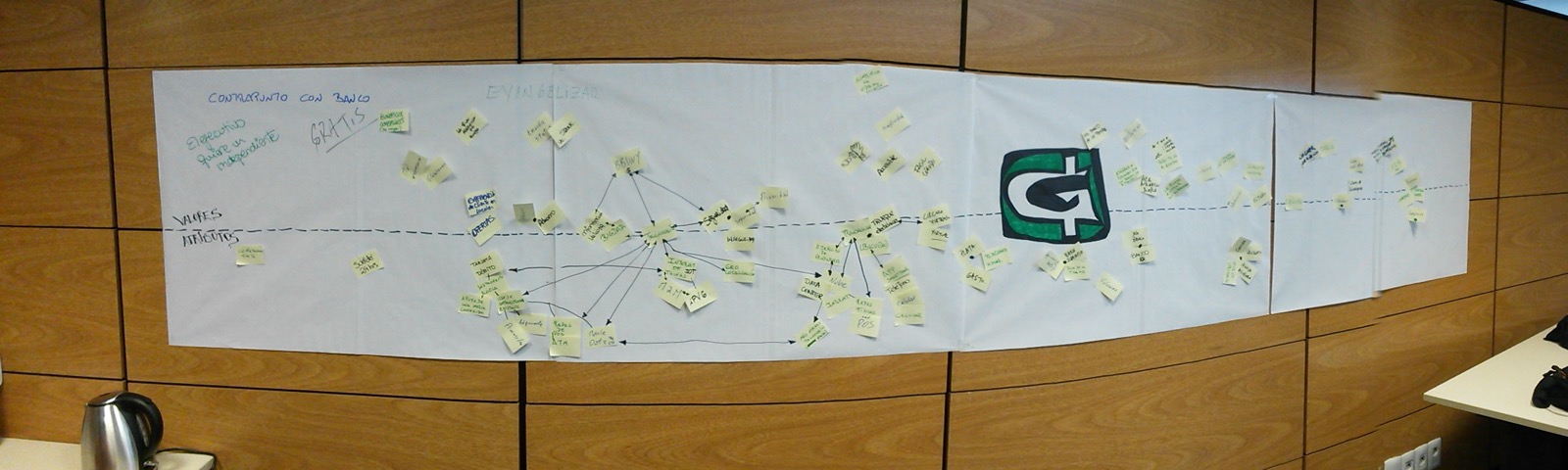
In the space of a few days, two posts from people I deeply respect sent me back in time. Daniel Goldman shared something that took me to 2014, to a wall covered in sticky notes where we spent hours arguing about a product we could not yet name. Looking at that photo now, I can still spot notes about IoT and M2M on the wall, threads I would keep pulling for years. Then Alejandro Revilla wrote about jPOS finally bringing observability into the platform itself, which took me straight to my years in the payment trenches. Between the two, the nostalgia finally got me to put into words something I had only mentioned in fragments: how I really got into fintech, and the one instinct behind most of what I have built since.
I told a generic version of this in “fintech: +10 años”. This time I want to zoom in on one thread: open source, and why “let’s not build this from scratch” was never a slogan I picked up along the way. It was already how I worked.
An invitation, and a startup that never launched
In 2014, Javier Borkenztain invited me to join something that did not have a clear shape yet. Uruguay had just opened up with its financial-inclusion law (LIF), and there was a window worth chasing. The seed was Pagapp, imagined as an online version of the cash-payment networks everyone here knows, Abitab or RedPagos. It grew into something more ambitious: building one of the first electronic money issuers (IEDE) in the country.
And we got there. On the back of a real, working platform, the project earned one of the first electronic-money issuer licenses granted by the Central Bank of Uruguay, under the brand $ERO. What it never reached was real commercial operation: the startup did not make it, which was neither my first failure nor my last. That is the unglamorous but common fate of most attempts.
The instinct I brought with me
Here is the part that matters to me. When I joined, I had no fintech experience. What I did have was several years living inside Linux and open source, and a strong opinion about how to build.
At the time, the plan was to build a .NET platform to run the IEDE from the ground up, with a local software house, gsoft, a very capable team. The effort was just getting started. My reservation had nothing to do with them; it was with the from-scratch path itself. My reflex, then and now, was: why start from zero when a community somewhere has already solved 80% of this?
That reflex was not something I discovered at $ERO. I brought it in the door. A few years earlier, running technology for the EFFA/LIFAN automotive assembly plant in Uruguay, we adopted Adempiere as the ERP backbone for operations, logistics, invoicing and exports, years before Odoo became a common open-source ERP in the region. We did it together with colleagues from the EFFA team, Bruno Ferreira and Murilo, who would later found Dev&Co. and today maintain iDempiere, the community-driven successor to that platform. In the same period we ran a large eGroupWare installation. Building a company’s operational core on open source was, for me, business as usual.
So at $ERO I did what I always do: I went looking.
Finding Mifos
I found Mifos (then Mifos X), the open-source core-banking platform for financial inclusion, and it was an excellent foundation to build on. I threw myself into the community: I started joining the Bi-Weekly Mifos X Developer Meetings, reached out to its implementers such as Conflux Technologies in Bangalore, and even got to meet many of the people behind the project in person in San Francisco, including one of its founders, James Dailey. With their help I got Mifos running on AWS, and in a matter of weeks we had a very solid, fully working environment. That head start is the whole point of open source: not that a from-scratch team is any less capable, but that you get to begin from a mature foundation instead of a blank page. That platform was the one used to obtain the Central Bank license.
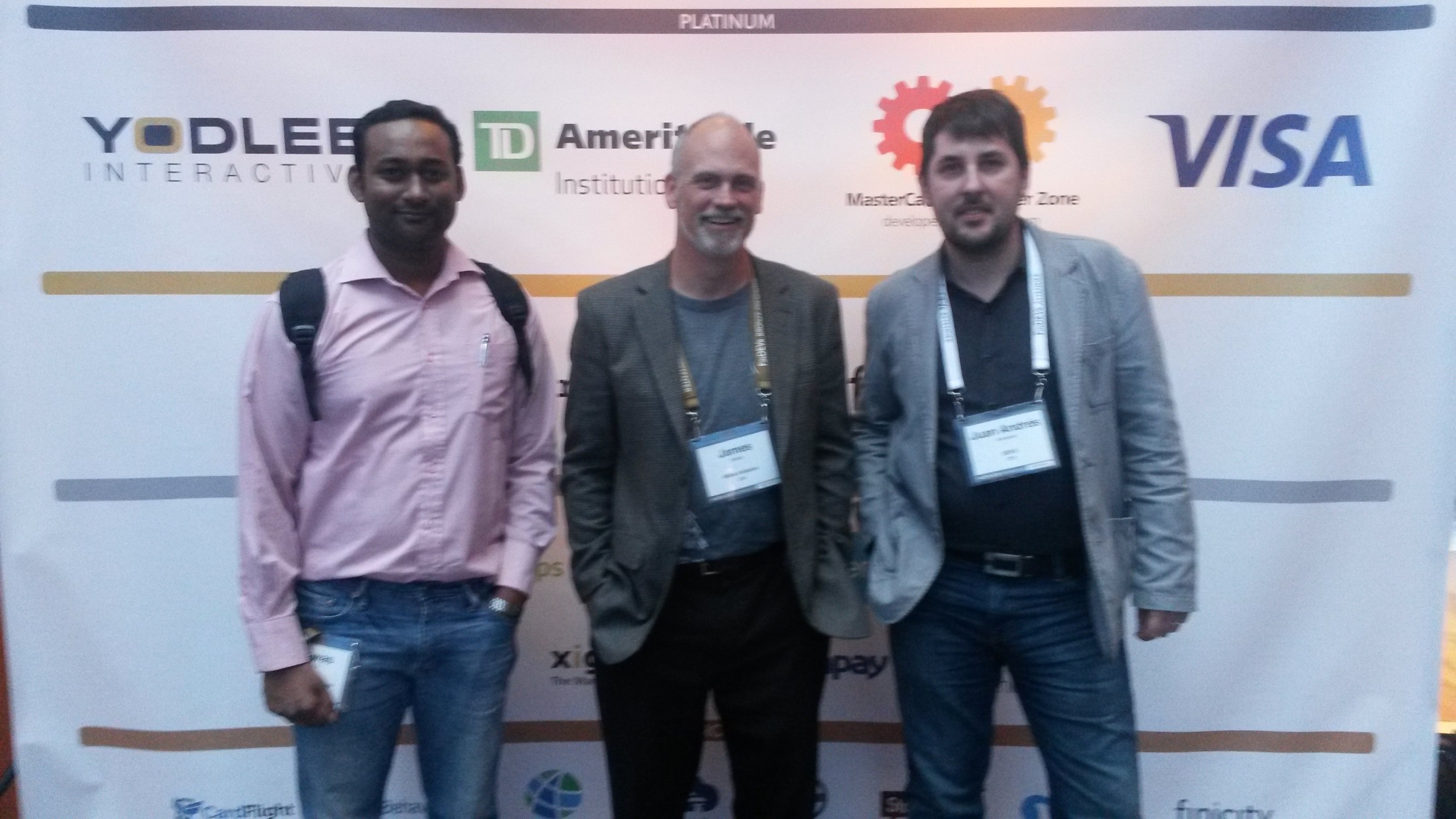 With the Mifos community in San Francisco.
Convincing the team was not easy. Betting a licensed financial institution on an open-source core, proposed by someone with zero fintech background, was a genuinely hard sell, and the debate was serious, as it should have been. But the team came around, and the approach kept paying off well beyond that first attempt. Javier went on to build his current company, Fiter, in that same open-source core-banking world (today built on Apache Fineract, the engine that grew out of Mifos). I am genuinely glad that approach outlived the startup.
Where everyone went next
$ERO did not launch, and in 2015 I was hired by Visanet (today Totalnet), where I spent an intense and productive decade in corporate fintech. That is where I got deeply involved with jPOS, the open-source engine behind so many payment switches in the region, and learned the transactional world from the inside. jPOS is, not coincidentally, another case of the same philosophy: a shared, transparent building block instead of a black box.
It is also where I first pushed hard on observability, bringing metrics and structured logging to a world that still lived on giant text logs, work I later took to the stage at DevOpsDays. My tool of choice back then, Elasticsearch, was far from perfect, but it worked in real production, and Alejandro Revilla, jPOS’s founder, was kind enough to take notice of it at the time. As he reflected more recently, sometimes timing matters more than perfection. So it genuinely makes me happy to see jPOS now bringing metrics, observability, and even an AI-assisted query layer into the platform itself, something I had long hoped to see.
Alejandro and I get along easily to this day, even though fluxrig now flies a parallel track to jPOS, built on Moov’s Go ISO 8583 stack rather than Java. That, to me, is the beauty of open-source diversity: there is room for more than one good answer to the same problem, and you can pursue a different one without it costing the relationship.
Javier and I have kept a warm relationship over the years, and every so often we look for an excuse to work together again; nothing concrete has landed yet, but the interest is genuine on both sides. From that same 2014 team, I built a lasting friendship with Fabian Lazovski, and we still find reasons to collaborate, most recently at COMUNO, the leadership community he directs. And while I have not kept in close touch with Jaime Lachowitz, it has always been warm whenever we cross paths. That is one of the quiet dividends of these early adventures: the projects end, the relationships do not.
The method never changed
Looking back, the technology changed completely (an ERP for a car factory, a core-banking platform for an e-money issuer, a payment switch), but the method never did. Find the giants, stand on their shoulders, and spend your energy on the part that is genuinely new.
It is the same instinct running through everything I take on today, whether as a fractional CTO across client engagements or in my own initiatives, from IoT to fintech. Through EBS I help institutions modernize their critical legacy systems across Latin America, without the reckless rewrite-from-scratch that sinks so many of those projects. And with fluxrig, as I wrote in “The 25-Year Long Game”, I have moved from being a consumer of open source to being a producer of it, and I try to stay close to the community that makes it possible, at events. The giant I found this time is NATS, a high-performance, cloud-native messaging system, and fluxrig is built on top of it. Same move as Mifos in 2014, only now I am building in the open instead of behind closed doors, and with the kind of AI coding assistance that did not exist back then, when finding and standing up Mifos meant documentation, mailing lists, and long nights.
Lately that same question, open or closed, is being argued at much higher stakes, about AI itself. It is worth understanding the difference between closed, open-source, and open-weight models, and why the Linux Foundation sees open models as foundational to secure AI. After a career built on open foundations, my view is not neutral: openness is not just a license, it is what lets you see, trust, and change the systems you depend on. It mattered for a payment core in 2014, and it matters far more for the AI we are all about to build on.
$ERO never issued a single peso. But it taught me that the way you choose to build matters as much as what you build. I have never regretted refusing to start from scratch.
These days I help fintech and financial teams modernize legacy and payment systems, through my work with EBS and the open-source project fluxrig. If you were around Uruguayan fintech in those early days, if you carry your own “never from scratch” story, or if you have a legacy system worth untangling, I would love to hear from you, get in touch.